
Hidden Water Leak? Emergency Leak Detection in Buena Park
Is it really a leak? Start with the water meter
The first sign is usually small: a water bill that jumped, a stain on a ceiling, a musty smell in a closet, or a faint hiss at night. Before anyone opens a wall, confirm that water is actually leaving your pipes.
Turn off every fixture, the dishwasher, the washing machine and the ice maker. Then look at your water meter, usually in a box near the street. If the small dial or leak indicator keeps moving with everything off, water is going somewhere it should not.
That check answers one question only: yes or no. It cannot tell you where the water is going, and that is the part that decides what kind of repair you need. A moving meter with no visible water usually means a hidden leak, which is the situation leak detection in Buena Park is meant for.
Leaks and water losses of this kind add up quietly, and a quick check of the toilets, using the dye test in the table below, will inspect toilets for silent leaks before you pay for anything else.
If water is running now, close the main shutoff valve before you do anything else. Keep away from outlets, switches and the electrical panel if water is near them, and call.
| Meter result | What it suggests | What to do |
|---|---|---|
| Dial moves with all fixtures off | A leak somewhere on the property, inside or outside the house | Shut off the main, then call for locating the source |
| Dial stops, but the bill is still high | A leak that only shows under pressure or use, a running toilet, or higher use than you think | Check toilets with a few drops of food coloring in the tank, then call if the color reaches the bowl |
| Dial moves only when hot water is used | A leak on the hot side, often near the water heater or in a hot line | Call and mention the hot side so the right plumber is sent |
Where is the water going? Clues that point to the source
A leak is a path, and the stain you see is rarely where it starts. Water follows framing, pipes and slopes before it shows. Read the clues, then let the plumber confirm.
Fixture leaks show up under sinks, behind toilets and around tub spouts. Wall and ceiling leaks leave brown rings, bubbling paint or soft drywall, often below a bathroom or the water heater. Outdoor leaks show as soggy lawn, a patch that stays green in dry weather, or a wet spot along the foundation.
If your home sits on a concrete slab, a warm spot on the floor or the sound of running water with everything off points down, and the leaks under a foundation slab explains that case. If the damp spot is between the meter and the house, the problem may be the supply line itself, covered on the water line repair page.
- Brown ring on a ceiling that grows after showers: likely a drain or supply line above it.
- Musty smell, no visible water: a slow leak inside a wall or under flooring.
- Warped baseboards or lifting flooring: moisture under the floor covering.
- Hissing or running sound at night: pressurized water escaping from a pipe.
- Low water pressure at every tap: a leak upstream of the fixtures.
What a plumber should locate, document and quote
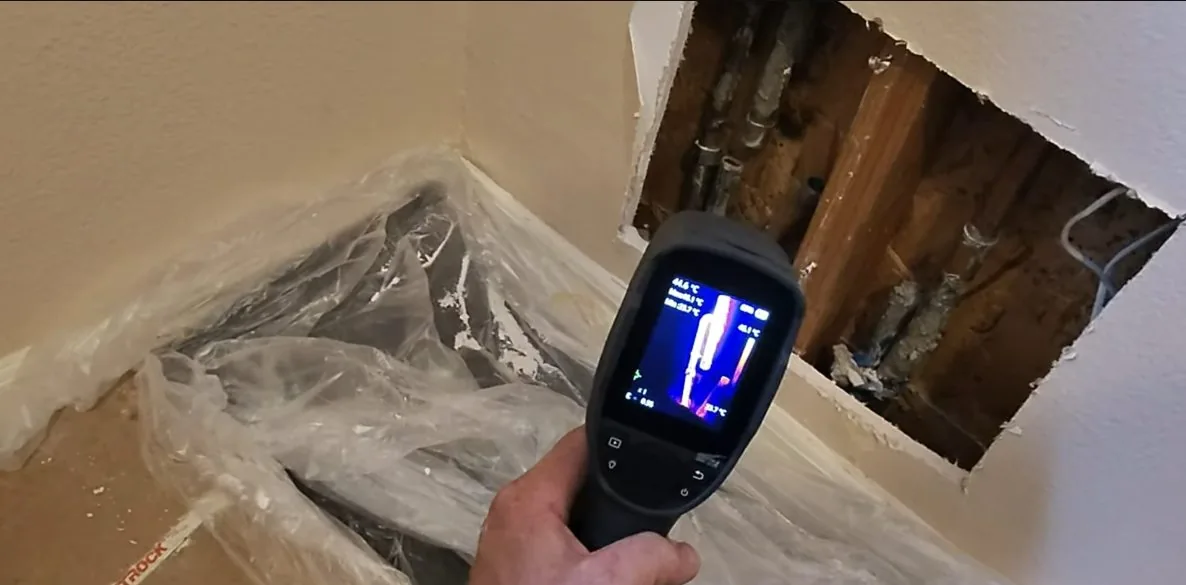
Good leak work starts with finding the exact spot, so that only one small area has to be opened. Ask how the plumber will locate the leak before any cutting starts. Common methods include listening equipment that hears water escaping from a pressurized pipe, thermal imaging that shows temperature differences behind surfaces, moisture meters, and pressure testing of a single line.
These tools narrow a search from a whole house to a patch of wall. A plumber who finds the leak with equipment can usually repair it with a smaller opening, and that means less drywall, flooring and paint afterward.
Before work starts, ask for three things in writing: where the leak is, what caused it, and what repair is proposed.
If the plumber finds pipe that is worn through in several places, ask whether a spot repair makes sense or whether the section should be replaced, a question that leads to the pipe replacement. Residential leak detection services should end with a clear description of the problem, not just an opened wall.
Some plumbers add infrared cameras, tracer gas such as helium for lines that are hard to hear, and a hydrostatic plumbing test that holds one line under pressure for a set time. Used alone or together, these give a precise leak location, and the plumber should write down the leak location documentation: the room, the wall, the depth and the method that confirmed it.
A plumbing inspection of the visible lines, shutoffs, water heater and attic plumbing can turn up other weak spots on the same visit, which is why a plumbing system inspection often travels with a leak inspection service. Ask about leak history too, because past repairs, stains and bills tell the plumber where to look first.
| Method | Best for | Limit to know about |
|---|---|---|
| Acoustic listening | Pressurized supply lines in walls, slabs and yards | Background noise and plastic pipe can make it harder |
| Thermal imaging | Hot water lines and wet areas behind finished surfaces | Shows temperature, so a plumber still has to confirm it is water |
| Moisture meter | Confirming how far damp has spread in drywall and wood | Tells you where it is wet, not where the leak starts |
| Pressure test | Proving a single line leaks and ruling others out | Needs the line isolated, which can take time |
Fixing the leak once the source is found
Once the leak is located, the repair depends on what failed. A loose supply fitting under a sink is a small job. A pinhole in a copper line inside a wall is a section repair. A fixture that leaks at the base is a part replacement, and the toilet and faucet repair page covers those.
Plumbing leak repair in Buena Park often comes down to a short list: a failed fitting, a worn washer or valve, a cracked pipe section or a line corroded from the outside. The plumber should explain which one you have and show you the failed part when possible.
Water leak repair is also where you decide how much to open. Cutting a clean access hole at the located spot is neater than a series of exploratory holes, and the plumber can tell you what finish work remains afterward. Ask who handles drywall patching and paint, because plumbing crews usually stop at the pipe.
The common leak problems a plumber solves on a visit are short: failed fixture fittings, pinholes in supply lines, worn valves, a cracked trap and corroded connections near the water heater. Wall and ceiling leaks usually trace back to one of those.
A homeowner sometimes sees a dripping faucet and a spotty ceiling at the same time and assumes they are one problem. They are often separate, which is why a leaky faucet repair and a hidden leak search can both be needed on one visit.
Who else owns the problem? Roof, irrigation, landlord or City
Not every wet spot is a plumbing leak. A roof or gutter leak shows up after rain, not after you run the shower. Sprinkler and irrigation lines are a separate trade, and a broken sprinkler head can mimic a yard leak, so mention it when you call. A plumber can still tell you whether the water in the yard is on your supply line.
If you rent, tell your landlord or property manager about the leak and keep your own photos with dates. If you live in an HOA building, ask whether the leaking line is yours or shared, because water from a neighbor's unit or a shared line is handled differently.
On the street side of your meter, the pipe belongs to the City. For meter and service-line questions, call the City of Buena Park Water Department at (714) 562-3655. A plumber can tell you which side of the meter the leak is on, and that decides who fixes it.
Older homes leak in more places
The City's draft housing element counts roughly 78.5 percent of homes as built before 1980, with the 1950s the biggest decade. Decades of wear show up in pipes, valves and fixtures.
City documents do not list pipe materials, so ask what the plumber found before you agree to a repair or a repipe.
Source: draft 2021-2029 Housing Element, age-of-housing table, with the pre-1980 share added up from its rows.
Call now or wait? Let the water decide
Some leaks cannot wait, and some can wait for a morning appointment. If water is running into a ceiling, flooding a floor or coming through a wall, shut off the main and call right away. A warm spot on a floor, a fast-moving meter or a growing ceiling stain are also reasons to call now.
A slow drip under a sink, a single faucet that weeps, or a small stain that has not changed in weeks can be scheduled. Put a bowl under the drip, take a photo of the stain with a date, and watch it.
Small leaks are easy to ignore, and that is the trouble. Ignoring small leaks lets water soak framing and insulation, so warning signs of hidden leaks, such as leaky ceilings causing water stains, a musty smell or bubbling paint, show up late.
Structural damage from water leaks builds over months, so catch small leaks early and handle them before the damage caused by ignoring leaks reaches wood or concrete. Humidity hides leaks as well: a bathroom that never dries out can mask a slow weep.
Dispatch is staffed all night, so a leak at 2 a.m. is handled the way a noon call is. The dispatcher wants your address, what you can see and what you have already shut off.
From there the call goes to one of our plumbers or to an independent plumber in our network who works your part of Buena Park. Arrival times shift with demand, and none is promised on the phone.
If the leak has already soaked flooring or drywall, read about drying and cleanup after water damage once the water is stopped, because damp materials can grow mold if they stay wet.
What homeowners ask about leaks
Can I repair a pipe leak myself, or do I need a plumber?
For a loose compression fitting or a dripping trap, a homeowner can often tighten or replace the part. For a leak inside a wall, ceiling or floor, a plumber is the better call, because the source is hidden and the wrong repair can leave a second leak.
If you are unsure, shut off the water to the fixture or the main and call. A short visit to locate the leak costs less drywall and time than guessing.
Do I need a plumber for water leaks I can see?
A visible drip from a fixture can sometimes wait for a scheduled visit. Water that keeps flowing, stains that spread, or a leak near wiring or a gas appliance should be seen by a plumber soon.
Visible water is usually the end of the path, not the start. A plumber can check the line above the stain before the repair is made at the wrong spot.
What is a hidden or underground leak, and how do I know I have one?
A hidden leak is water escaping where you cannot see it: inside a wall, under a floor, or in a buried supply line. Signs include a water bill that rises with no change in use, a meter that moves with every fixture off, soggy ground, or a patch of lawn that stays green in dry weather.
Start with the meter check on this page. If the meter keeps moving, shut off the main and call so the leak can be located before more water is lost.
How do electronic, thermal or acoustic leak detection methods work?
Acoustic equipment listens for the sound of pressurized water escaping from a pipe. Thermal cameras show temperature differences behind surfaces, which helps with hot water lines. Moisture meters measure how far dampness has spread.
A plumber often combines two methods to confirm the spot. Ask which one was used and what it showed before any cutting begins.
Leak somewhere you cannot see?
Call and describe what you notice. Dispatch passes you to a local plumber, and you can ask for the location, the cause and the repair to be explained before work begins.
Where else to look
- Slab leak repairWhen the leak is under the floor slab
- Water line repairWhen the leak is on the main or yard line
- Toilet and faucet repairFixture leaks and running toilets
- RepipingPinhole leaks and failing pipe
- Water damage restorationWhen the leak has already caused damage
Looking for another fix? Browse every plumbing service or see the cities nearby.